
Published in the Lackawanna Historical Society newsletter
There’s something comforting about having a box (or five) of old photos tucked away in the closet or attic. We think, “At least we still have them.” Or “there are so many and the kids don’t care, so why bother?”. And that’s true—having the photos is a start. But I’d like to invite you into a deeper layer and perspective of what it means to be a memory keeper, family historian, or simply someone who treasures the people who came before us and their importance.
Because here’s the truth: collecting photos and connecting with them are two very different things, did you know that?
I’ve seen it many times—boxes passed down from one generation to the next, moved from one house to another like family heirlooms. But unless we pause to engage with those photos, ask questions, listen to stories, and preserve the meaning behind them, they remain just pieces of paper with an image on them. So, is connecting with your collection important? Yes. But powerful? Not yet.
When a Photo Holds More Than an Image
Have you ever looked at a photo—not just glanced, but really looked—and suddenly felt something shift or move your heart somehow? Maybe it was your great-grandmother’s eyes looking directly into the camera. Perhaps it was a candid of your dad laughing in a way you hadn’t remembered him. That’s the moment when the connection begins.
Photos are memory triggers, emotional breadcrumbs. They invite us to pause and wonder, to reflect and to feel. They can bring us to tears, flood us with questions, or wrap us in the warmth of belonging. But only when we stop to listen.
There is deep emotional meaning in being seen and remembered. And there’s something profoundly healing – especially for future generations—in knowing that their people lived, struggled, celebrated, created, loved, and mattered. In these moments, we don’t just see our ancestors—we feel them. For me, it’s a moment of time–travel as I feel as if I’m present as the photographer or as a witness of the moment. We remember that our stories didn’t start with us. And that realization can ground us in ways that no document ever could.
What Happens When We Don’t Connect
When we don’t take time to connect with the people and moments in our photographs, the images risk becoming artifacts without context. Future generations might inherit the box, but without names, places, or stories, those faces will eventually fade into the anonymity of some unknown, distant relative’s basement, or even the trash.
Worse, we lose the chance to say, “This is where I come from.” We miss the emotional thread that ties us to our past and reminds us who we are—and why it matters.
And yet, the connection is there, waiting. It doesn’t have to be elaborate or perfectly documented. A name written in pencil. A note about the picnic. A memory sparked in a conversation. These are the tiny but mighty bridges between collecting and connecting.
Even a few simple stories can breathe life into an entire collection of the past generations, as well as YOUR collection of photographs! The moment we start to know the people in those photographs—even a little—we turn forgotten images into a living, breathing narrative of resilience, love, and belonging.
The Gift to the Next Generation
I believe every story we uncover adds depth not just to our understanding of the past—but to our families’ futures. When you give a child or grandchild a photo with a story attached, you give them more than an image—you give them identity. You give them a sense of belonging. You help them see that they are part of something bigger.
And maybe even more importantly? You show them how to remember. You model for them that stories matter. That people matter. That they matter.
You help them build roots—not just in facts and figures, but in heart and soul.
A Gentle Nudge to Begin
So yes, hold on to those boxes of photos. But go one step further. Sit with them. Talk about them. Write down what you know, or ask someone who might know more. Share a story with your family—even a small one. Better, and possibly easier yet, record our voice and preserve the audio story along with a digital copy of the photograph or photographs, or handwrite the story to accompany the physical pictures.
This work doesn’t require perfection or research degrees. It just requires heart. It requires curiosity. And a little time. Because when we connect with our images, we’re not just archiving the past. We’re shaping the emotional legacy of the future. We are giving our families—and ourselves—the incredible gift of continuity.
And that, friends, is worth far more than a box of pictures.
Just one photo. Just one story. Just one connection. That’s where it begins.
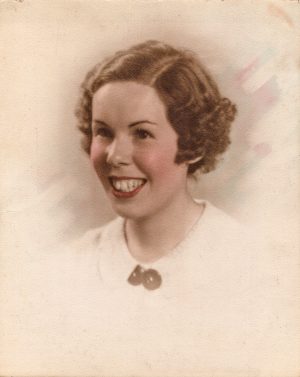
Photo: This is my maternal grandmother, pictured in 1937—the year before my mother was born. I love this photo because she is genuinely happy. I see my mother’s eyes, my own smile, and a sense of joy I don’t remember seeing as a child. I was always a little afraid of her for reasons I couldn’t quite name. She passed away in 1970 when I was just seven, and I know she struggled after my